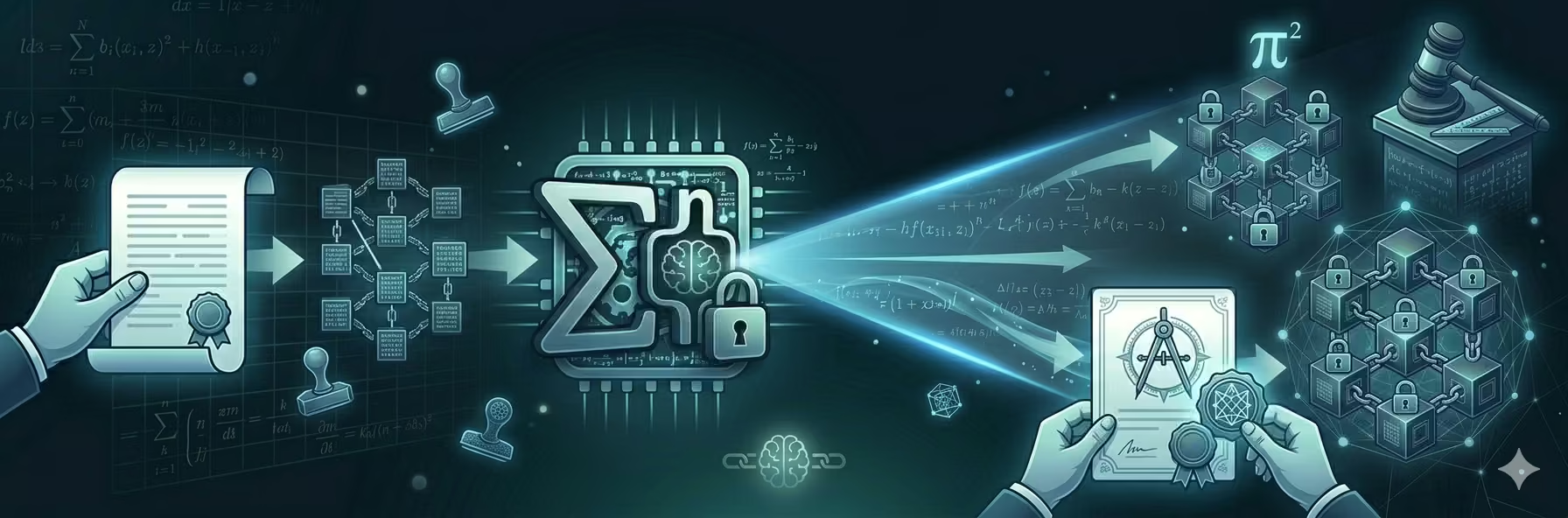
Why VerixID Cryptographic Signatures Are Impossible to Forge
Every record logged on VerixID receives a cryptographic seal — a digital stamp whose integrity can be independently verified by anyone, including VerixID itself. This is not a marketing promise. It is pure mathematics.
⏱ 4 min read🏷 Security
Imagine receiving a physical document from someone claiming to be a notary public. How do you know the seal on that document is authentic rather than a forgery? You cross-reference it against an authorized, registered notary seal.
VerixID operates on the exact same principle, but with absolute certainty — because trustworthiness isn't backed by institutional reputation, but by mathematics.
A Digital Seal That Cannot Be Duplicated
Whenever a record is logged into the VerixID ledger, the system automatically stamps it with a unique digital seal. This seal is entirely distinct to each individual record — no two records will ever share the same stamp.
Known technically as a digital signature, this stamp is generated using an advanced cryptographic framework called Ed25519. You don't need to understand complex backend mathematics to benefit from it. What matters is this: the seal can only be generated by VerixID, yet anyone can verify its authenticity instantly.
A Simple Analogy
Picture VerixID holding a master cryptographic seal. Every single document we process is stamped with it. We publish an authentic sample of this seal openly at verixid.com, allowing anyone to verify a record at will. If the seal matches, the document was definitively issued by VerixID.
Three Terms, One Core Concept
VerixID Digital Signature Glossary
🔏 Seal
The cryptographic signature attached to every VerixID record. Unique per record and impossible to replicate.
🪪 Seal Sample
The VerixID public key — published openly at verixid.com/.well-known/ so anyone can cross-reference it anytime.
✅ Match
Successful verification confirming the record was genuinely issued by VerixID and has remained unaltered since creation.
The Chain of Trust
Trust in VerixID's cryptographic seals roots back to a standard infrastructure element everyone already trusts: HTTPS. Your browser automatically verifies that verixid.com is authentic. From there, an unbroken chain of trust extends mathematically.
Chain of Trust
1. verixid.com — trusted by your browser via HTTPS/TLS
↓ publishes
2. /.well-known/verixid-public-key.pem — authentic VerixID seal sample
↓ used to verify
3. ed25519_signature — stamp embedded in every ledger record
↓ verification outcome
✅ "This seal was created by VerixID — no one else"
What This Means For You
When you or any third party verifies a record on VerixID, three critical properties are mathematically guaranteed rather than merely promised:
🔢
01
File Unaltered
The SHA-256 hash proves the file is identical to the one originally registered — any modification, no matter how minor, is instantly detected.
🔏
02
Genuine VerixID Record
The cryptographic signature proves the record originated directly from VerixID and was not fabricated or tampered with by external actors.
📒
03
Immutable Timestamp
The timestamp is stored within an immutable ledger structure — ensuring nobody can alter when a document was initially registered.
Even VerixID Cannot Lie
This is perhaps the most crucial aspect of the architecture: cryptographic signatures don't just protect you from malicious outsiders — they also prevent VerixID from altering data.
Once a record is signed and committed to the ledger, no entity — including the VerixID engineering team — can modify its content without breaking the signature's validity. If any tampering occurs, verification fails instantly. Automatically. Without exceptions.
The VerixID Principle
"We don't take sides. Math does." — We build systems where mathematical proofs replace empty promises.
No. VerixID digital seals utilize the Ed25519 cryptographic algorithm — a mathematical guarantee that signatures can only be created using VerixID's private key. Anyone can verify authenticity using our publicly published public key. There is no mathematical shortcut to forge a valid signature without holding the private key.
VerixID publishes its official public key openly at verixid.com/.well-known/verixid-public-key.pem. Anyone can cross-verify the signature of any record against this key. A successful match proves the record was genuinely issued by VerixID and has not been altered.
Not at all. Simply input your Record ID on the VerixID Verify page — the digital signature is displayed instantly. For advanced technical verification using standard cryptographic tools, step-by-step instructions are available in our documentation.
Standard electronic signatures focus primarily on identifying the signer. VerixID cryptographic signatures prove that a data record was officially issued by VerixID and remains completely untampered with since registration, prioritizing absolute data integrity. Both approaches complement each other.