Acceptable Use Policy
Effective date: March 1, 2026
This policy constitutes an integral part of our Terms of Service and is legally binding for all Users.
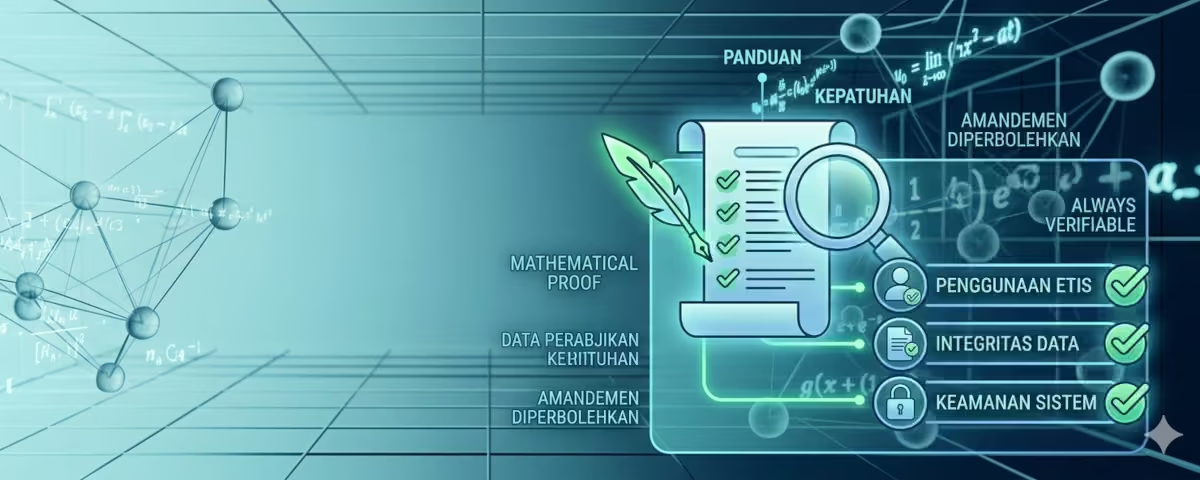
1. Purpose of This Policy
This Acceptable Use Policy ("AUP") complements the VerixID Terms of Service by defining operational guidelines on permissible and prohibited actions within the System. Violating this AUP may result in immediate suspension or permanent termination of access.
2. Permitted Uses
The System is designed for:
- 2.1 Registering and verifying the authenticity of legitimate files
- 2.2 Establishing cryptographic proof of existence for documents at a specific timestamp
- 2.3 Securing intellectual property, commercial contracts, digital assets, and critical documentation
- 2.4 Auditability, compliance, and legal verification within legitimate business operations
- 2.5 Enterprise system integration via available APIs
3. System Capabilities & Technical Scope
Before using the System, please review the technical parameters of what VerixID can and cannot prove:
3.1 What VerixID Can Prove:
- a. An exact, byte-identical file existed at the recorded timestamp
- b. The file contents have remained untampered since initial registration
- c. The initial registrant holds the designated Ownership Key as proof of record control
3.2 What VerixID Cannot Prove:
- a. The legal identity, honesty, or intent of the registrant
- b. The factual accuracy, legality, or underlying validity of the file content
- c. Ultimate legal copyright or proprietary intellectual property ownership
- d. Subjective intent or goodwill of any party
- e. That the registrant is the lawful owner of the submitted file
3.3 Technical Scope & Ledger Architecture
a. VerixID operates exclusively at a mathematical level—every file generates a cryptographic hash that matches only an exact, bit-for-bit duplicate. Files subjected to compression, format conversion, or re-encoding will produce a completely different hash, even if the visual document remains unchanged. This service is designed for digital-native assets, not digital reproductions of physical documents.
b. Hashes originating from any payload—including illegal content—can technically be committed to the ledger because the System does not parse or inspect file contents. However, such submissions strictly violate this AUP and subject the user to immediate enforcement. The ledger is immutable—records cannot be deleted or modified even if proven to violate policy. This is a fundamental architectural property, not a security vulnerability.
c. VerixID assumes no obligation to proactively monitor, filter, or review User activity.
4. Prohibited Uses
Prohibited activities include, but are not limited to:
4.1 Illegal Content
You may not register cryptographic fingerprints of files that contain or constitute:
- a. Materials that violate applicable laws in any relevant jurisdiction
- b. Content infringing upon third-party copyrights, trademarks, or intellectual property rights
- c. Child Sexual Abuse Material (CSAM) or Child Sexual Exploitation and Abuse (CSAE)
- d. Content advocating violence, terrorism, or unlawful hate speech
- e. Unauthorized personally identifiable information (PII) of third parties
4.2 System Misuse & Deception
- a. Registering files belonging to third parties without authorization to fabricate ownership claims
- b. Utilizing VerixID records to defraud, deceive, or misrepresent facts to external parties
- c. Misrepresenting a VerixID record as legal certification beyond its technical scope
- d. Attempting to exploit, tamper with, or compromise the integrity of the ledger infrastructure
- e. Utilizing the System for money laundering, illicit financial flows, or sanctions evasion
4.3 Technical Abuse
- a. Executing automated high-volume requests (flooding/DDoS) that disrupt service stability
- b. Exploiting vulnerabilities outside our responsible disclosure program
- c. Bypassing or exceeding established system rate limits via automated tooling
- d. Reverse engineering any component of the VerixID platform for malicious purposes
- e. Using the service as a proxy, relay, or obfuscation mechanism for third-party exploits
4.4 Violation Assessments
- a. Determinations of policy violations are based on objective impact and potential system harm, regardless of subjective user intent.
- b. VerixID reserves the right to enforce remedies based on active policies at the time of evaluation.
- c. Enforcement actions are calibrated according to the severity, frequency, and systemic risk of the violation.
5. API Usage Guidelines
API consumers are strictly required to:
- 5.1 Maintain strict confidentiality of API credentials and prevent unauthorized distribution
- 5.2 Report any suspected API key compromise or credential exposure immediately to VerixID
- 5.3 Comply with all enforced rate limits and bandwidth quotas
- 5.4 Refrain from using the API to build competing document verification services without express written authorization
- 5.5 Ensure downstream end-users of applications powered by VerixID APIs comply with this policy
6. Consequences of Violation
VerixID reserves the right to unilaterally execute the following actions without prior notice:
- 6.1 Formal warnings and temporary access restrictions
- 6.2 Permanent suspension or termination of accounts and API credentials
- 6.3 Automated IP blocking and network-level access restrictions
- 6.4 Formal escalation and reporting to law enforcement authorities
- 6.5 Cooperation with law enforcement agencies in legal investigations
Enforcement actions do not remove existing cryptographic records from the ledger—the ledger remains immutable[cite: 10]. However, platform interface and API access will be permanently revoked[cite: 10].
7. Reporting Violations
To report known AUP violations or malicious activities within the ecosystem, contact our security team via the Contact Page.
For technical security vulnerabilities, please submit reports through the Security Report Channel.
8. Policy Updates
We reserve the right to amend this Acceptable Use Policy to reflect technical updates, legal requirements, or emerging security threats. Revised versions will be published on this page with an updated effective date.
9. Contact Us
For inquiries regarding this policy, please reach out via our Contact Page.